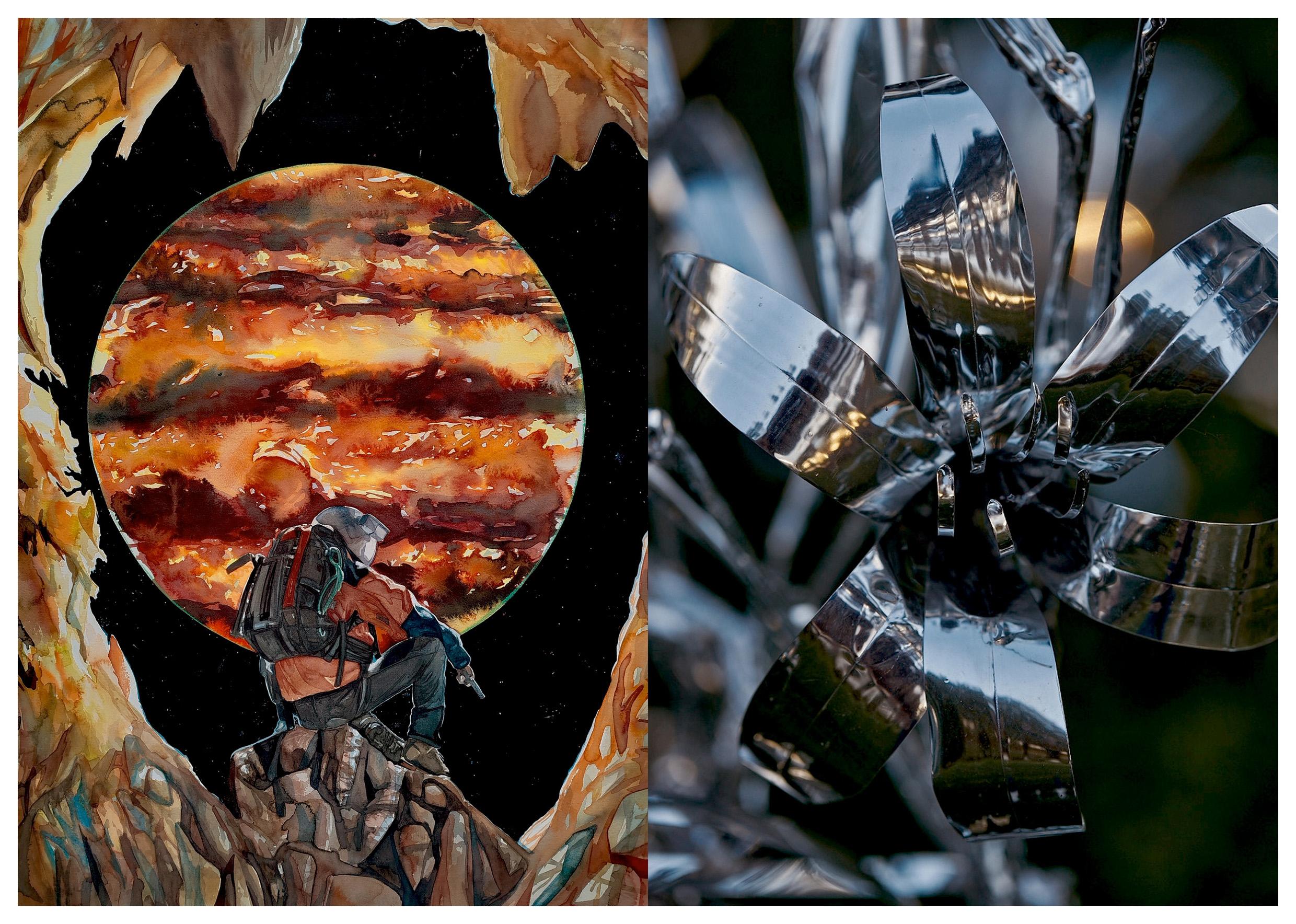
At the heart of the exhibition is the ancient Delphic maxim “Mēdèn ágan” – “Nothing in excess”. Once carved in stone at the entrance of the Temple of Apollo, it still reminds us that every measure, every order, and every being rests on a fragile balance. If this measure is exceeded, the structure begins to sway – in the human, in nature, in the cosmos itself. From this idea, the exhibition unfolds two artistic perspectives on the fragility of the world – and on how it is precisely in this fragility that its beauty and preciousness lie.
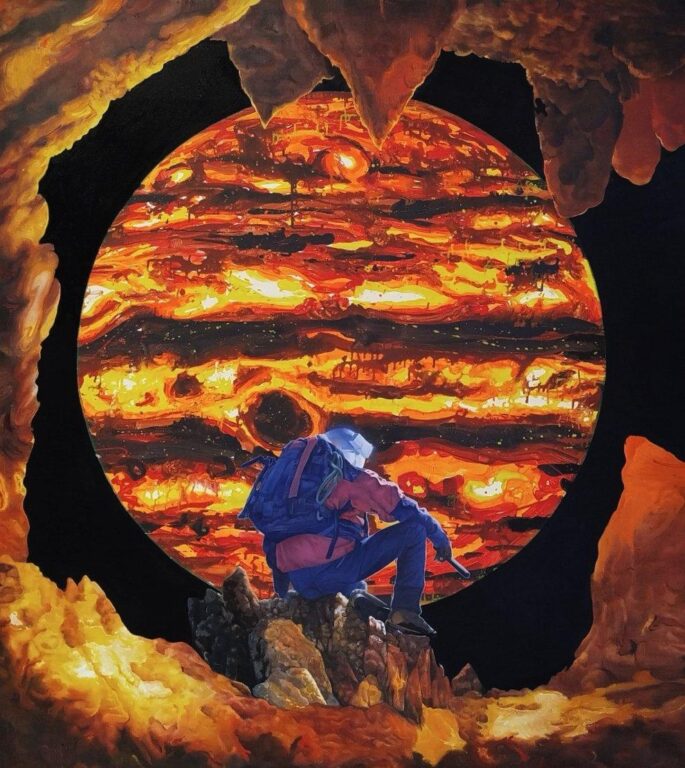
Paris Giachustidus’ paintings reflect this idea on the level of knowledge. Inspired by astronomy and the unsolved mysteries of the cosmos, they reveal a tension between the desire for knowledge and uncertainty. The more we know, the greater the questions become – and the more uncertain our knowledge appears. This tension between knowledge and uncertainty becomes visible in Giachustidus’ works – as a poetic reflection on the unknown and the limits of human understanding. In individual paintings, a figure appears who – similar to the iconic back figure of romantic landscape painting – stands before the vastness of the universe. This constellation vaguely recalls the wanderer in Caspar David Friedrich’s “Wanderer Above the Sea of Fog”, but the perspective shifts here: the human is no longer the sovereign observer above nature, but appears small and vulnerable in the face of cosmic dimensions. It is precisely in this that a posthumanist idea can be recognized. The works liberate the human from its traditional position as the measure of all things and place it in a larger network of forces, processes, and unknown orders. The universe appears not as a stage for human knowledge, but as a space that relativizes and expands our perspective.
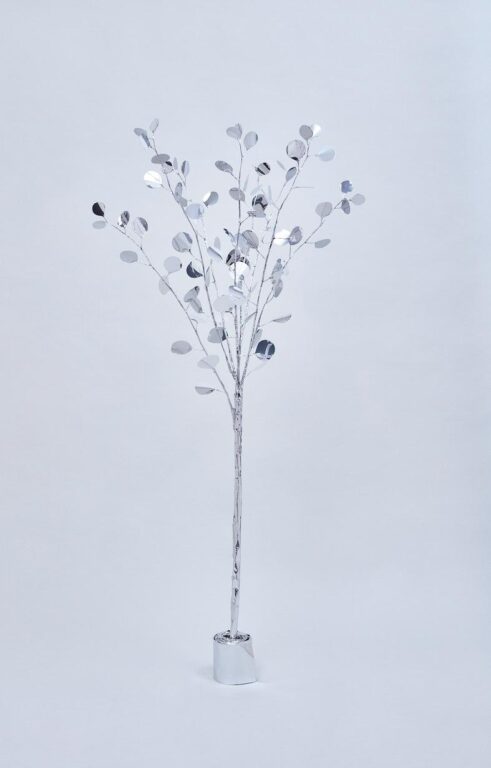
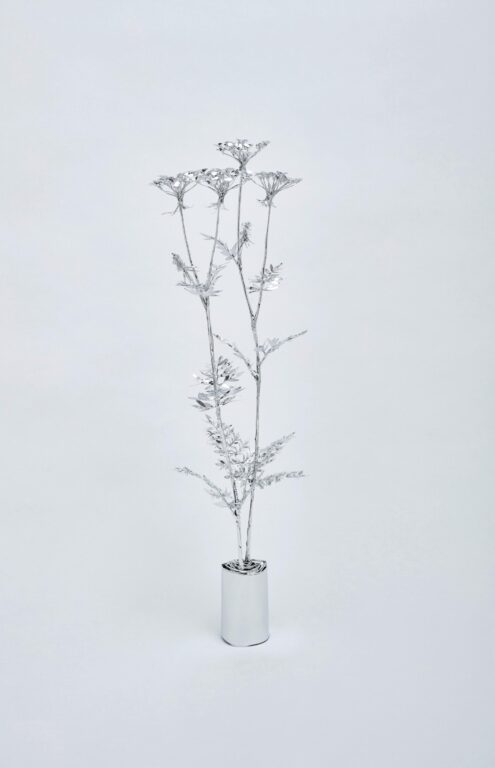
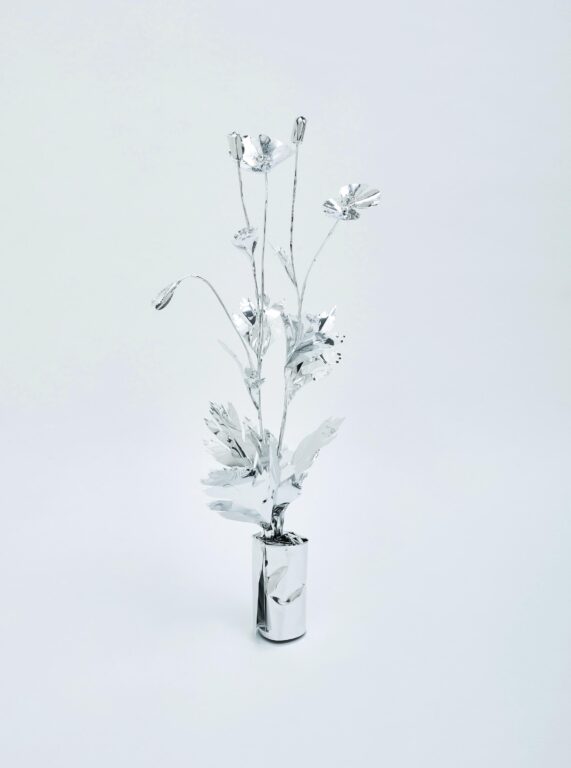
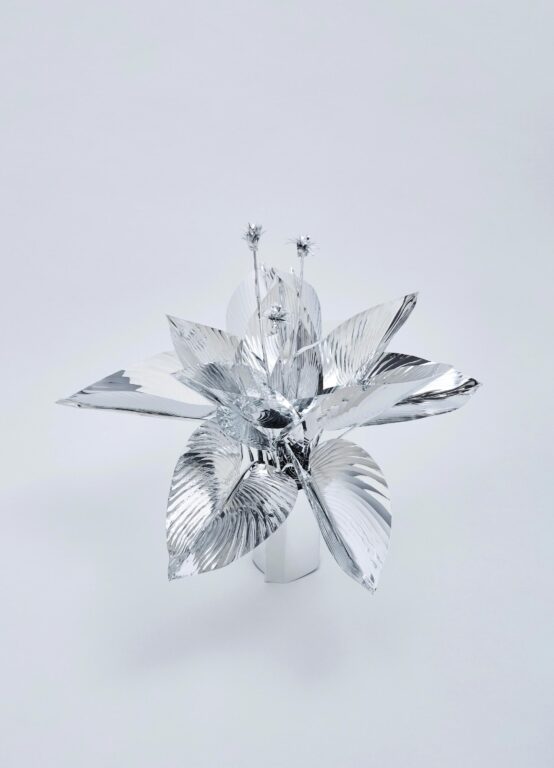
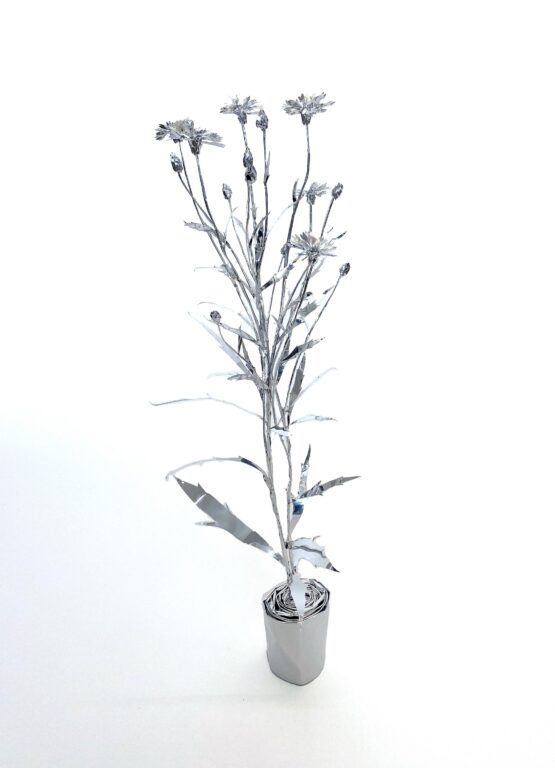
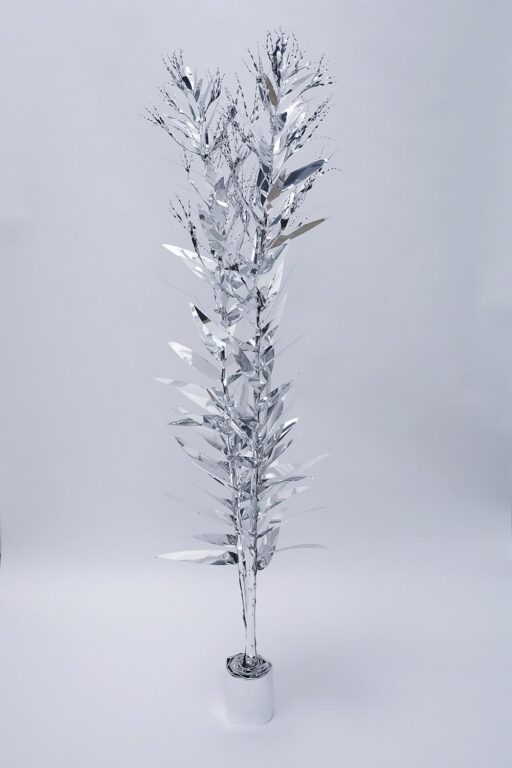
The works of Toshihiko Mitsuya turn to the material side of this fragility. His sculptures are made of thin aluminum that is cut, folded, and condensed into complex forms. From the initially inconspicuous material, constructs emerge that remind one of plants, flowers, or organic growth processes. The shiny surfaces reflect their surroundings and change with the light, so that the sculptures oscillate between clear form and fleeting appearance, depending on the perspective.
Many of these works are conceived as installative arrangements that consciously integrate into their environment. In the encounter with landscape, weather, and vegetation, situations arise in which artificial and natural structures overlap. Mitsuya’s sculptures appear like fragile metal plants – as if they were part of a garden that is both constructed and grown.
His works thus address fundamental questions of materiality and change. The seemingly stable metal suddenly appears sensitive and vulnerable, while the delicate forms develop a surprising resilience. In this field of tension between stability and instability, the notion of a world becomes visible in which change and transience are not the exception, but a fundamental condition of life.
The exhibition brings these perspectives together: it shows that uncertainty and instability harbor not only threat, but also aesthetic and philosophical potential. In the interplay of Giachustidus’ cosmic uncertainty and Mitsuya’s material fragility, a reflection on the beauty of the transient, the limits of knowledge and power, and the ethical responsibility of humans in a fragile universe emerges.